

Andrew McCutchen, for all that he was put through in the off-season, should have stayed in center field
Jeff Roberson/AP
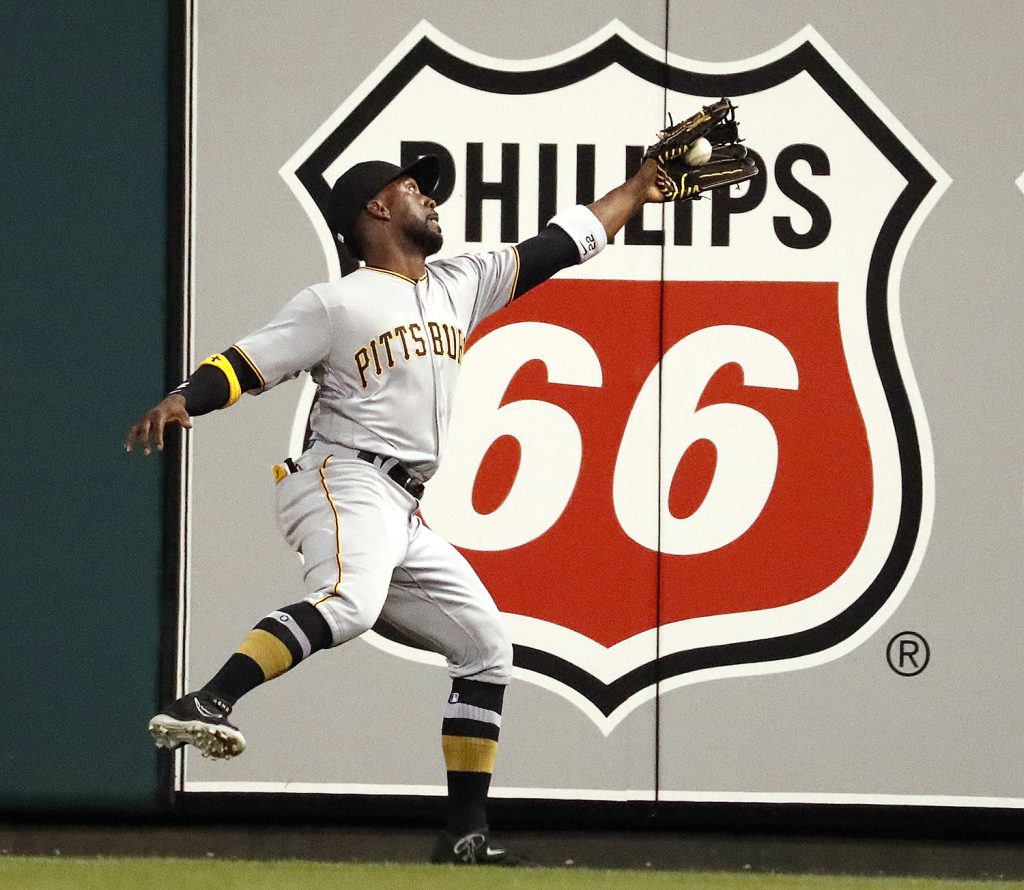
Pirates center fielder Andrew McCutchen catches a fly ball by St. Louis CardinalsÎÞëÊÓƵ™ Mike Leake during the third inning on April 18 in St. Louis.
Associated Press photo/Calkins Media graphic
PITTSBURGH ÎÞëÊÓƵ” With Starling Marte out for the next 78 games while serving his suspension for violating Major League BaseballÎÞëÊÓƵ™s substance abuse policy, the expectation is that Andrew McCutchen will get the majority of the playing time in the middle of the PiratesÎÞëÊÓƵ™ outfield until he returns.
Center field is obviously a place with which McCutchen is familiar. He has stared more than 1,100 games there in his MLB career and heÎÞëÊÓƵ™s just as happy to continue playing there, as evidenced by his emphatic reaction to a catch he made in the right-center field gap on Tuesday.
ÎÞëÊÓƵœThis is my spot,ÎÞëÊÓƵ� McCutchen mouthed.
It brings into question whether McCutchen should have been moved in the first place.
ThereÎÞëÊÓƵ™s no doubt that Marte, who replaced McCutchen in center field, is a quality defender. Marte has a cannon of an arm and led the National League in outfield assists in 2016. HeÎÞëÊÓƵ™s also faster than McCutchen.
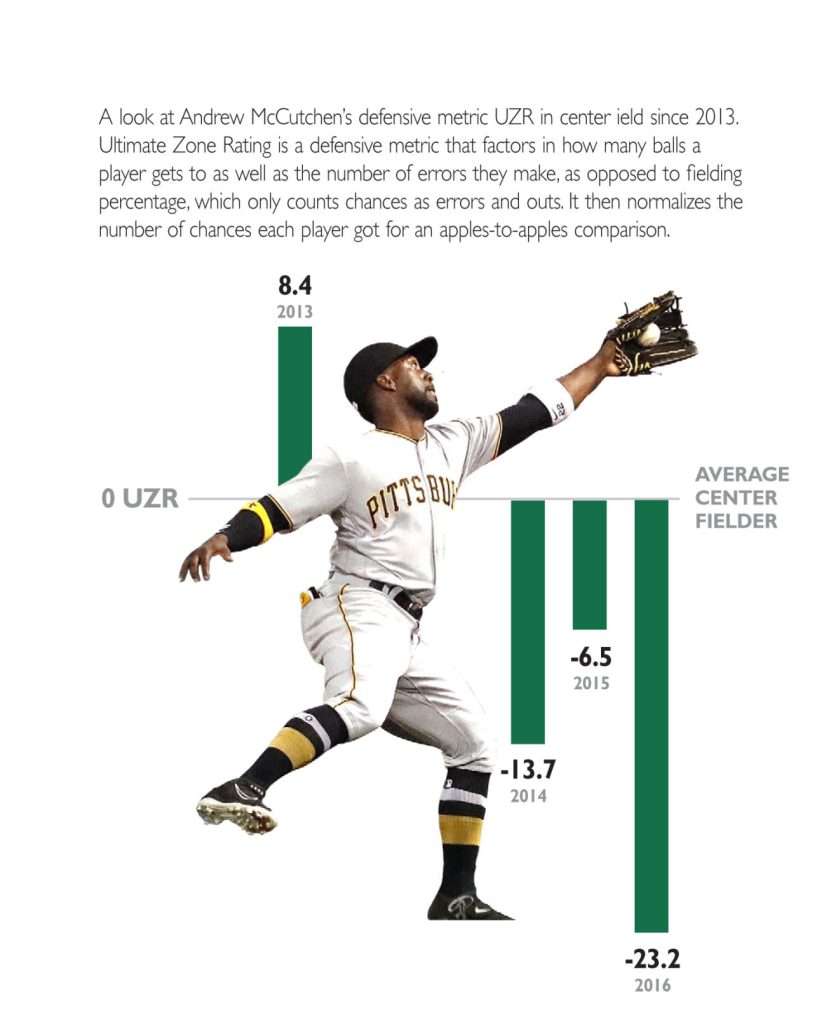
McCutchen had seen his defensive play in center decline. He had a -23.2 UZR/150 last year ÎÞëÊÓƵ” the worst among qualifying centerfielders. UZR (Ultimate Zone Rating) is a defensive metric that factors in how many balls a player gets to as well as the number of errors they make, as opposed to fielding percentage, which only counts chances as errors and outs. It then normalizes the number of chances each player got for an apples-to-apples comparison.
The trend line on McCutchenÎÞëÊÓƵ™s career numbers doesnÎÞëÊÓƵ™t provide for much hope of a rebound, either. His best season came in 2013, with a UZR/150 of 8.4. But it fell to -13.7 in 2014 and rebounded to -6.5 in 2015 before last seasonÎÞëÊÓƵ™s cliff dive. Marte has a career number of -11.8, which is still below average, but projects to be a significant improvement.
So the numbers say that Marte should be a better centerfielder, and to an analytically driven team like the Pirates, maybe thatÎÞëÊÓƵ™s enough.
But while the front office has dived head-first into the charts and graphs part of baseball analysis, manager Clint Hurdle is often quick to point out the ÎÞëÊÓƵœhuman analytics,ÎÞëÊÓƵ� meaning it doesnÎÞëÊÓƵ™t do any good for anyone to have a great idea if it doesnÎÞëÊÓƵ™t get a buy-in from the players.
While Hurdle has made no public statements in opposition to moving McCutchen ÎÞëÊÓƵ” in fact, he played a large part in getting the teamÎÞëÊÓƵ™s star player to accept the move ÎÞëÊÓƵ” his words on the human side of the equation ring true at times. Players are not robots. Things like ego and emotion do matter on the field and in the clubhouse.
The Pirates were already in a bad place when it came to the human analytics of the way they handled McCutchen this off-season. After publicly dangling him in trade talks, they were never able to consummate a deal, meaning that the face of the franchise returned to the club despite it being a tenuous situation on either end.
McCutchen wanted to play for the Pirates and was on the record many times as saying that he wanted to finish his career in Pittsburgh. But that all changes when a team is publicly shopping a player. McCutchen deserves a lot of credit for coming back into the clubhouse and doing and saying the right things. Asking him to move positions on top certainly has not made it any easier.
There are other factors to be considered, as well. While McCutchen remains on the roster, itÎÞëÊÓƵ™s nearly a certainty that he will be traded at some point before his contract ends at the conclusion of the 2018 season. If McCutchen could put together a decent defensive season, he could significantly increase his trade value to the Pirates. General manager Neal Huntington also has admitted that the teamÎÞëÊÓƵ™s change in defensive position in 2016 hurt McCutchenÎÞëÊÓƵ™s play. Just rectifying that could provide some increase in performance.
McCutchenÎÞëÊÓƵ™s actions on the field on Tuesday in St. Louis make it obvious that playing center field is what he feels he should be doing. Maybe, given everything else the Pirates asked him to do over the last year, that should have been enough.